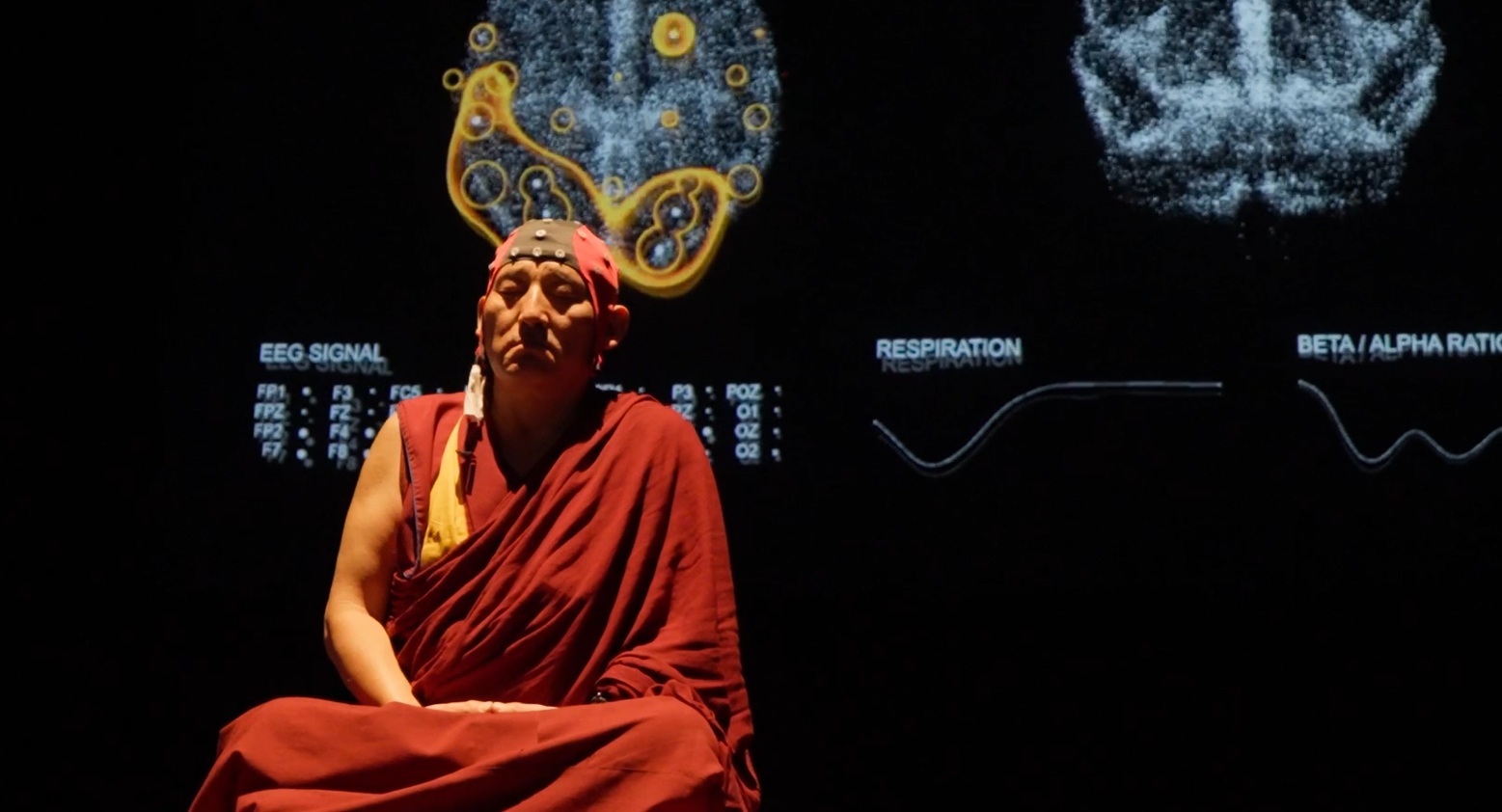
Artificial intelligence can distinguish between different styles of Buddhist meditation just by looking at EEG recordings of a person’s brain, as shown by researchers at LENS.
Researchers from the Department of Physics and Astronomy at the University of Florence and the European Laboratory for Non-Linear Spectroscopy (LENS), together with Università Campus Bio-Medico di Roma, the National Institute of Optics of the National Research Council (INO-CNR), and the Fondazione per la Ricerca Contemplativa, have investigated whether machine learning can recognize different styles of meditation purely from a person’s brainwaves. The study, published in Frontiers in Artificial Intelligence, shows that Shamatha, Vipassana, and Metta meditation (three traditional styles of Buddhist meditation) carry recognizable signatures in the EEG recordings taken during the practice. The patterns associated with each style are detailed enough that machine learning can tell them apart with high accuracy when looking at recordings from the same person, but it is yet unable to identify an overall “meditation signature” when comparing different people. The work was carried out at LENS, coordinated by Alessandro Scaglione and Professor Francesco Saverio Pavone.
“Many EEG studies have demonstrated that the brain indeed looks different during meditation compared to rest” says Saqib Hayat, first author of the study. “We wanted to investigate whether the brain looks different depending on which meditation a person is practicing”. While part of the same Buddhist meditation tradition, Shamatha is focused on concentration, Vipassana trains investigative awareness, and Metta cultivates compassion and kindness. “These are different mental exercises, and we wanted to know whether they leave different, recognizable fingerprints in the EEG.” says Hayat.
The team recruited 15 experienced meditators who were asked to perform each of the three meditation styles for 15 minutes, preceded by a 4-minute mind-wandering baseline, while wearing EEG caps. Sessions took place at Terra di Unificazione Ewam in Florence, a Tibetan Buddhist study and meditation center, where many participants are already used to practice. From the EEG recordings, the researchers extracted different descriptors of the signal (such as frequency, wavelength etc) to identify which measurements were most informative. They then used machine learning to train classifiers to recognize the four mental states of the practitioners: mind-wandering, Shamatha, Vipassana, and Metta.
“We tested the classifiers two ways,” explains Alessandro Scaglione, who supervised the study together with Pavone. “First, we trained and tested a model on the same person’s data, to see how well it recognizes what that individual’s brain is doing at different moments. Then we trained a model on fourteen people and tested it on a fifteenth, someone it had never seen, to check whether that recognition would generalize to a new person.”
The results in the first case were strikingly consistent. Within a single person, meditation was almost always correctly told apart from mind-wandering, with accuracies above 90%. Even the three meditation styles could be distinguished from one another within an individual, with accuracies between 86% and 93%, and all four mental states together were correctly classified around 83% of the time. “When we tested across people, the picture changed substantially: distinguishing meditation from mind-wandering in someone the algorithm had never encountered before was still reasonably accurate. But discriminating between all three classes of meditation had an accuracy of 41%” explains Scaglione. Mapping each person’s brain individually gave the researchers distinct clusters for each of the four mental states, but the picture became muddled once the reading for all participants overlapped. “Everyone’s Shamatha looked recognizably like Shamatha to their own brain, but not necessarily like anyone else’s. We can think of it as a sort of accent, rather than a universal language,” says Scaglione. “Each person meditates in a way that’s internally very consistent and easy to recognize once you know them, but that consistency doesn’t automatically translate from one brain to the next.”
“These results point toward a specific, and in our view more realistic, application,” adds Professor Pavone. “Rather than a one-size-fits-all method to recognize anyone’s meditation style, we can move towards personalized neurofeedback: a system, potentially app-based, calibrated on an individual’s own brain activity, able to tell that person when they’ve entered the meditative state they intended to reach, and to help them track how their practice evolves over time.”
The researchers thank the Centro Terra di Unificazione Ewam in Florence for hosting the recording sessions, and His Eminence Khangser Rinpoche and the Thangkar Institute in Nepal, together with the Istituto Lama Tzong Khapa in Pomaia, for their guidance on the meditation practices involved in the study.
References
Hayat, S., Goretti, F., Fabbri, R., Noferini, C., Cravero, E., Mori, P., Scaglione, A., Pavone, F. S. Meditation styles are highly discriminable from EEG at the subject level with limited generalization across the population: a machine-learning study. Front. Artif. Intell. 9, 1876322 (2026). https://doi.org/10.3389/frai.2026.1876322